Showing posts with label Yexue Li. Show all posts

Saturday, May 29, 2010

review week

As we reviewed the notes from all the visitors this week, I found it very helpful to put them together. I have to say that all the visitors who came to our class were those who are quite successful in their field and they did not success because of luck. They all have passion of what they are doing and they know what they are doing. They are all very good at planning their career, it is not just about networking and being good at getting money, it is a lifestyle they chose, and they are all responsible of their decisions.

Saturday, May 22, 2010

a little thought about copyright

The copyright in China is awful. A lot of people say it is the bad side of China. But I can understand, because no one is going to pay to download music if there’s the same thing available online for free. That is just human nature. But I did not understand it until I was walking in Chinatown in NY, and there were many street vendors selling DVDs of the latest movie with a really cheap price, I think it was about 3 to 4 dollars. And to my surprise, most of the customers were Americans. Of course no one is going to the movie theatre if they can just watch it at home for 3 bucks.

And it is the same for those designer’s bags. Who is going pay $2000 for something looks the same but you only need to pay $200? I know it is not the same, I know. But in that Silk Road Market next to the US embassy in Beijing, 80% of the customers were foreigners. And those vendors knew at least 5 different languages, but all about selling and bargaining. They started to switch languages when they saw me not responding to their Chinese.

Saturday, May 15, 2010

oh my favorite J&J

Artists follow their passions. They don’t care about their meal for the next day or their rent for the next month. It is the attitude of life. I remember in one of my studio art seminar class, prof. Neilson said to us: all of you sitting in this classroom, the most normal life you will have in the future is bohemian. 

I have known J&J for three years, they are the greatest advisors and they always inspire me. One of my most important things they ever told me about photography was when I was struggling printing photographs for my solo exhibition. I was about to collapse under the pressure and anything was just not right. I showed them my sample prints and they did not think it right too. Julie looked at me and said: there was no love. I did not get it at that time, not until very later on when I finished using a box of 11x14 fiber paper for one photo, it finally came about right. And I saw love. I remembered that I ran into J&J’s office and cried out “I found love!” And then I understood, it was the passion in it, not just about photography, it was about anything you are working on, even including this project for this class. It is the passion that makes it wonderful and it is the love.

Saturday, May 8, 2010

'Pop-up' gallery shows aim to sell condos as well as art

By Jessica Dawson
Friday, January 15, 2010

A Cinderella-like transformation of condos into art galleries -- one night only! three weeks only! -- has been going on in Washington's Shaw neighborhood for the better part of the economic downturn. Artists and developers link arms to throw art shows in unsold, high-design 2BR/2BAs along U Street and up 14th.

These pop-up galleries-in-a-condo are such a phenomenon that a new crop of impresarios has emerged to connect the creatives with the capitalists. Some are DIY veterans who aren't in it for the bucks. They might get a little cash, but the bulk of their rewards are notoriety and the satisfaction that their artist friends can pay the rent. Others hail from art consultancy backgrounds and are tweaking their businesses to serve developers.

Newest among these on-call middlemen is Wool, a roving gallery business that debuted on a chilly Thursday last month. It's a collaboration between Billy Colbert and Ryan Hackett, both artists and veteran DIYers. Hackett was a founding member of erstwhile collective Decatur Blue; Colbert has organized a host of artist-run events in the District and Baltimore.

Hackett likens Wool to Temporary Services or No Longer Empty, organizations in Chicago and New York, respectively, that fill fallow, mostly developer-owned spaces with art. The pair embrace the freedom from gallery overheads.

"We were not interested in money, only in throwing a show," Hackett says.

On the December night of Wool's debut, Colbert and Hackett invited the city's grooviest to the Lacey, a 26-unit condominium at 11th Street and Florida Avenue NW for an event they called "Bauble."

Guests milled near the Fisher & Paykel stainless fridge in Unit 101 (a 2BR/2BA w/den going for $759,000) and chatted over backbeats pumped from a DJ stationed downstairs. One couple -- she in a Moncler puffy jacket, he in skinny jeans -- attempted a makeshift dance floor. Next door in Unit 102, real estate agent Debi Fox held court among Saarinen knock-offs.

Along the wall (and on pedestals), works by some of Washington's more interesting young artists were installed with all the professionalism of a gallery. Among the artists: Cory Oberndorfer, Kathryn Cornelius and former D.C. artist Jose Ruiz. Each work was priced to sell at $250.

Was "Bauble" an art show or a dance party or an open house? Yes, yes and yes.

Yet for art partisans, it was a strange night. Yes, "Bauble" was one of the best exhibitions of this kind. The art looked good, artists made money and a charity benefited. (Wool designated that $100 from each sale go to Project Create, which offers free art programs for at-risk children. Disclosure: I sit on the board.) But the focus that night was condos.

Though the building's developers deny that the event helped sell Unit 102 (currently under contract), the buzz about the Lacey and its art were clearly part of a larger business plan.

Similar art events are the specialty of the Art Registry, a six-year-old consultancy that specializes in the "excitement of the art world transported to unique marquis properties," its Web site says. The registry recently worked with Ernst Development and Willco Residential.

Co-founded by Erin Mackay, a Washington Project for the Arts board member, and photographer Jill Lubar, the Art Registry works like this: Developers donate space; Mackay and Lubar shoulder marketing and installation expenses. Art Registry clients -- young professionals earning enough to afford both art and real estate -- gather for a party and (it is hoped) pull out their checkbooks.

Mackay puts her group's gross from most events at $15,000 to $80,000. An event last April at Providence lofts on 11th Street yielded $28,650 in art sales. Mackay says the artist "always receives 50 percent or more" of the sale price.

For the Providence project, Mackay called on Philippa Hughes, an art impresario who links collectors with artists working in graffiti and street art. Hughes brought in District artist Decoy. Proceeds were split among Hughes, the Art Registry and the artist.

But who really benefits? The developers, that's for sure -- they get branding, foot traffic and buzz. The marketers behind the Providence were shocked by how many people the Art Registry pulled in.

"We had a tremendous turnout, and I think that we sold at least 50 percent of the building because of that event," says Jeremy Aldridge, an agent for Urban Pace, the sales and marketing firm behind Providence. "It was hard to distinguish who was there looking at the units and who was looking at the art, so it created a kind of urgency. That was brilliant marketing."

Brilliant marketing for developers. But bad PR for art? One-offs forge dicey synaptic connections in the public mind: They reinforce the "art as decor" paradigm, divorcing artists from their highest calling -- creating work that challenges social and political norms. On art event nights, artists become another kind of interior decorator.

Then again, this is real life. Artists need to eat and developers need to sell. Not all art is created equal -- and neither are its venues.

The next Wool event is scheduled for March at an as-yet-named space on Ninth Street NW.

The Art Registry is at http://www.theartregistrygroup.com.
This article is from The Washington Post.

Dawson is a freelance writer.

Friday, April 30, 2010

example mission statement of a pop-up gallery

Triple Base is a project space that strives to facilitate new and innovative ways to promote and assist emerging Bay Area artists, to instigate dialogue with artists from various regions and to encourage cross-disciplinary collaborations. Brought together by a shared interest in site-specific and multi-disciplinary contemporary art practice, co-curators Joyce Grimm and Dina Pugh invite artists working in areas of film/video, social practice, music, painting, drawing and sculpture to create new work while considering the parameters of site, scale and location. Triple Base seeks to aid emerging artists in at a crucial point in their careers, and to encourage them to create projects that go beyond the usual scope of their art making practice. Integral to our artist-centered mission is Triple Base’s arts education programming that benefits our diverse audience, artists and interns.

Saturday, April 24, 2010

To be or not to be, it is a question.

I still remembered the day when I made the decision of changing my major to studio art. I came to Lawrence as an econ & math major, and the ECON 100 class I took in the winter of my freshman year and I did not get along very well, apparently we did not like each other. In China, only people who cannot go to a good college would go to an art school, and both of my parents and all my relatives said that I was wasting money and time. I thought about it again and believed that there was no other way out. Just like Prof. Troy said in class today: “You should not be a freelance artist if you can think of anything else you can do that makes you happy.” I’m not saying that I have to be a freelance artist, but really, I don’t know what I am going to do if I’m not doing art. I wish I did not choose art and art did not choose me, so I don’t have to quarrel with my parents over and over again. I guess it is like a “to be or not to be” question to me, it is either life or death. I have not regretted my decision so far, I don’t know what I will think 10 years later, I don’t know if I would say “I could have become an investment banker”, or would I be happy as a starving artist. We will see.

Wednesday, April 14, 2010

Occident & Orient Opening


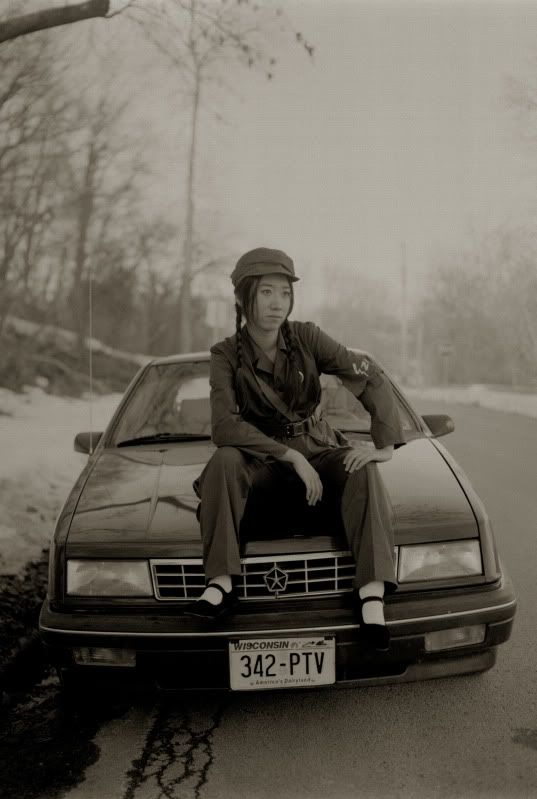
Hi Guys, my honors project “Occident & Orient” opens at Mudd Gallery on Thursday, April 15, 2010. This is an art show of photographs about Chinese identity embracing, rejecting then merging with the West, through Chinese critical view of the western culture over three periods of time: 1930s, 1960s and the present.

The opening reception is on Thursday, April 15, 2010, from 6 to 8 in the evening.
Hope to see you there!

The show runs until April 27th.

Monday, April 12, 2010

When Fear Rules the Photography World, We All Lose

When Fear Rules the Photography World, We All Lose
One morning you wake up, and it’s facing you. Everything you took for granted and that made your life comfortable is suddenly gone. Probably forever. Welcome to the economy of fear.

Your formerly cozy job, which once brought you a new batch of creative challenges every day, now brings you a daily dose of doubt and uncertainty. From photo editors who are not sure how long they will keep their jobs, to staff newspaper photojournalists who could be shooting their last images, everyone is living in fear.

In the last decade, the photo industry has pivoted from an economy of wealth and abundance to an economy of fear. It is not so much about talent, creativity or effectiveness anymore. It’s about who can scare the other into submission.

Decision-Making Based on Fear
Pricing for example, is no longer based on usage, or talent, or even level of professionalism. It is based on the fear that someone else could price it lower and thus take the sale.

Whether assignment or stock, images are priced on how high they can go before losing out to the competition; these days, that is not high. Photo editors negotiate with the “I can get it cheaper” stick raised overhead — forcing photographers and agencies into fearful submission. There is little conversation about quality anymore.

The fear factor goes beyond pricing. Companies like Getty Images approach and retain photographers on fear. If you do not work with Getty, they claim, your images will never be published. If you work for a competing agency, you will never work for Getty, and so on.

It’s a bit like Walmart’s infamous strong-arming of its suppliers: “We own the market, we own you.” Some Walmart suppliers, by the way, have been forced into bankruptcy, because they were forced into unsustainable low pricing.

Stock shooters fear the ever-growing crowd of microstockers. Photo agencies fear other photo agencies. Wedding photographers fear lower-cost wedding photographers. Photo editors fear their bosses. Publishers fear the future.

On top of that, almost everybody fears Orphan Works, the Electronic Frontier Foundation, the government, new technology, and in some cases, even their car.
Recently, an image-matching company released a report saying that eight out of 10 images appearing on commercial Web sites are being used “non-legitimately,” offering their service as a solution. Fear as a selling strategy. If I scare you enough, will you buy my product?

Magic Potions and Security Blankets — for a Fee
When the future is uncertain, like it currently is in the photo world and elsewhere, it is natural to be worried and scared. No one can seriously say today that they know for sure where they will be five years from now.

However, for companies, or individuals, to capitalize on that fear, to use it as their primary bargaining tool is despicable. It is like pushing down on the head of a drowning person with the promise of saving them. A false promise.

Photography does not live well under fear. Creativity gets lost and conformity becomes the norm. Snake charmers invade the land with their make-believe magic potions, orators take to the podiums to agitate more fear and offer their security blankets — for a fee. Opportunists see opportunities to make deals that defy reason, well aware that fear is a powerful logic sedative.

We are going to see a lot of decisions driven by fear this year and next, mostly creating poor results for our industry. We’ll see a lot of people jumping off cliffs in order to avoid the fire. But mostly, we will see a lot of fear-smellers taking advantage of the situation.

original posted By Paul Melcher | Posted in Business of Photography

Sunday, April 4, 2010

marginal benefit vs. marginal cost

I was traveling around the east coast interviewing and taking photographs of people for my art project during the spring break, sometimes I had to be at three places in one day. For example, I was interviewing a girl from Yale in New Haven in the morning, a guy from Columbia in New York in the afternoon, and another guy from Bard in Rhinecliff in the evening.

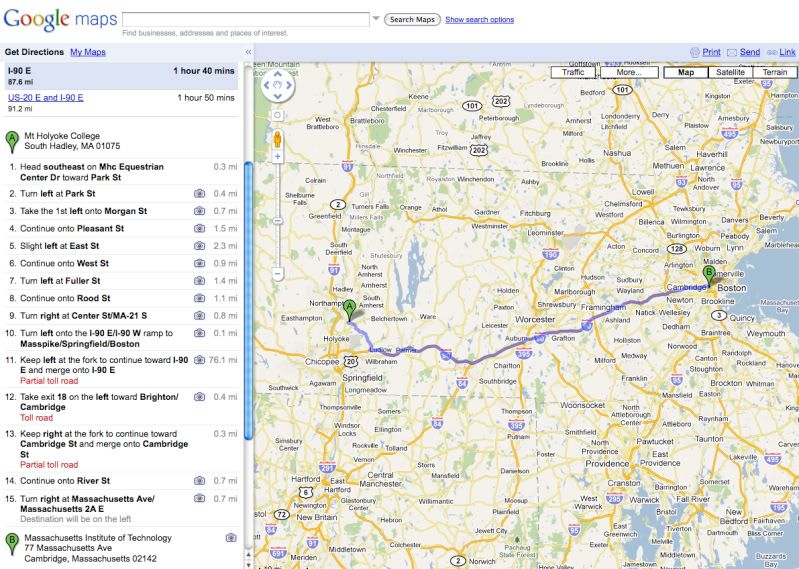
While I was in Boston to get to Mount Holyoke College, I checked all the transportation options, and at last I decided to rent a car ($112.78/day), because even though it was a lot more expensive than public transportation ($59 for LinkPass), the public transportation would have taken me 10 hours, which I could not afford for only two hours' worth of driving.
One of my friends asked me why didn't I take Peterpan which was only $60 for a round trip. I told her that it was not only because that it was 3 hours for a one-way trip, but also because I would have had to stay overnight for the next bus in the morning to take me back. I didn't know I was thinking about marginal benefit vs. marginal cost back then, but subconsciously I chose time over money.